Creating Stories With Children
《走路上学》观后感
Juni 2, 2022What are the key benefits of Early Childhood Education?
Juni 2, 2022It is important for children to make stories as well as to receive and respond to stories from other people. When we make stories we take our experience and make it meaningful for ourselves rather than waiting for other people to do it for us. When the children create and tell a story in a foreign language the story and the language become theirs.

Creativity is important in language teaching because:
- Language teaching, particularly of children, is about the development of one whole person, not just one minor aspect. Creativity, a key part of the child’s development, is enriching for the individual and for society.
- Some learners cannot apply their full intelligence if they are not given the opportunity and encouragement to be creative with a “new” language, even in their first week of learning it.
- By “playing” with the language children make it their own.
- Some learners need to experience a rich flow of the language in order to “feel” the character of each word.
Fluency is an important aspect of creativity. Fluency means, essentially, the willingness to ‘have a go’ with the language you have, whether it is in speaking and writing or listening and reading.
Of course, we need accuracy. However, accuracy and fluency need not be in conflict. Interesting and relevant ideas need to be clearly expressed, and correct grammar, spelling, and punctuation are parts of this.
But, what if my children don’t have enough language?
Here are some practical suggestions:
- Encourage any contribution.
- Don’t ask the children to think consciously about accuracy when they are thinking creatively.
- Do a lot of preparation before asking the children to work.
- Do a lot of oral story-making before moving into written story-making – both in terms of children’s overall development, but also within each activity.
- Write a lot of useful words and phrases on the board,
- Giving reassurance but a feeling of creativity.
- Rejoice in their willingness to contribute.
- Let story-making be a frequent activity rather than an occasional one.
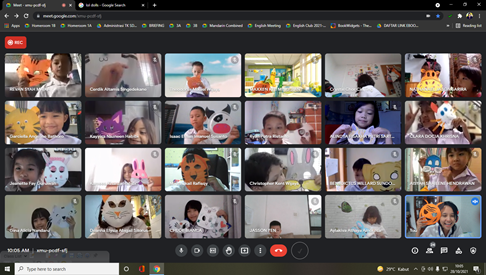
- Let other art forms or media enrich the presentation so that the effect is not one of a limited vocabulary at all. E-mail, books, scrolls, crazy books, and posters can be used to heighten and enrich a written story. Music, mime, masks, the overhead projector, and the audio and video recorder can be used to enrich the spoken form.